
Disclaimer: The information provided on BuySilverJunk.com is for educational purposes only and does not constitute financial advice. Precious metals markets are volatile. Please do your own research.
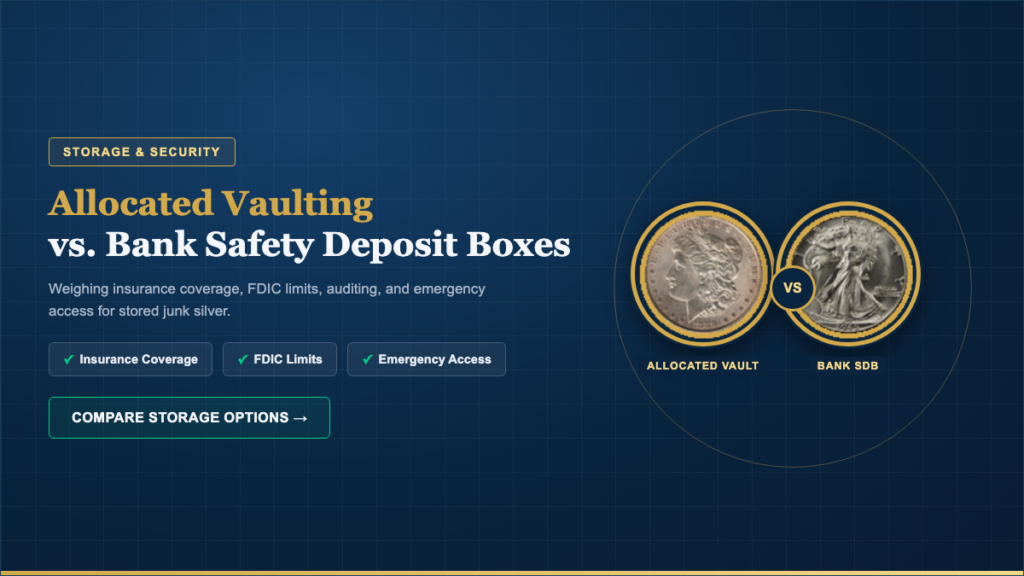
Once a junk silver stack grows past a few hundred coins, the question stops being “where do I put this” and becomes “who else can vouch for it.” A home safe keeps a stack out of sight, but a bank box and a private vault each solve a different problem — insurance, access, and proof of what’s actually there. Here’s how the three compare.
Bank Safety Deposit Boxes
A bank box feels safe because it’s inside a bank, but the fine print matters more than the location.
- Not FDIC insured: FDIC insurance covers deposit accounts, not the contents of a safety deposit box. If the box is burglarized or damaged, the contents are the customer’s own risk unless they’ve separately insured them.
- Limited access: You can only get to the box during banking hours, and a box can be sealed or frozen by court order, during probate, or on the account holder’s death — sometimes for weeks.
- Low visibility, low cost: Annual fees are usually modest, and nobody outside the bank knows what’s in it — a real advantage for a stacker who wants to stay quiet.

Allocated Private Vaulting
Private vaulting companies offer two very different products, and the difference matters a lot if the vault ever runs into financial trouble.
- Allocated vs. unallocated storage: Allocated storage means your specific coins are segregated, titled to you, and not part of the vault operator’s own balance sheet. Unallocated storage is effectively a claim against the company — if it goes bankrupt, you’re a creditor, not an owner. Always confirm allocated, segregated storage in writing.
- Third-party audits: Reputable vaults publish independent audits (from firms like Bureau Veritas or similar bullion auditors) confirming the metal that’s supposed to be there actually is. No audit trail is a red flag.
- All-risk insurance: Look for a policy that covers theft, fire, and natural disaster with a named insurer (Lloyd’s of London syndicates are common), not just a vague “fully insured” claim on the website.
- Access: Most private vaults offer extended or 24/7 access with appointment, a step up from bank hours — though this varies by facility.
Which Should You Choose?
There’s no single right answer — it comes down to the size of the stack and how much you value access versus audit-grade proof.
- Small stacks (a few hundred coins or less): A bolted-down home safe or a bank box is usually enough. See our guide to fireproof home safes for junk silver for what to look for.
- Growing or larger stacks: Allocated private vaulting is worth the added cost once the insurance and audit trail start to outweigh the convenience of home access.
- Any stack, regardless of size: Pair whatever storage method you choose with sound OPSEC — see our home security and OPSEC guide for the habits that keep a stack from being a target in the first place.
Most stackers start with a home safe, add a bank box as a low-cost backup, and graduate to allocated vaulting once the stack’s value justifies third-party audits and all-risk insurance. Match the storage method to the stack you actually have today, and revisit the decision as it grows.